What a business website should actually do
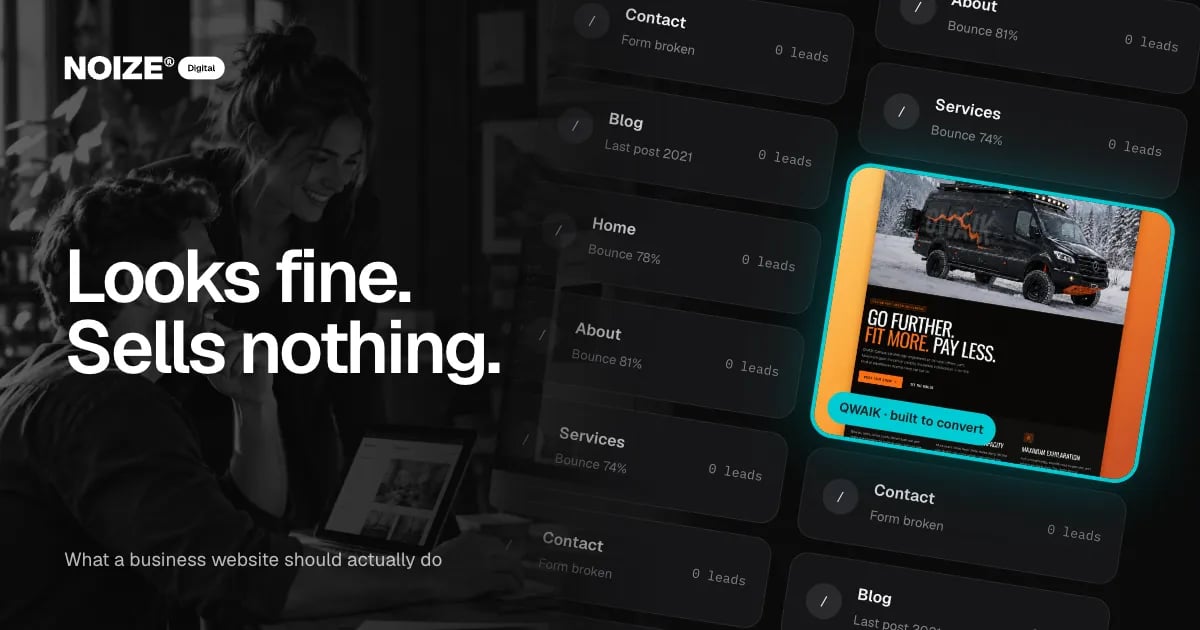
The website looks fine. It has a nice home page, an about page, a services page and a contact form. It also produces almost nothing. Visitors arrive, look around and leave. The contact form hasn't been tested since launch. Nobody can say how many customers the site brought in last month.
This is the most common website problem we see, and it has nothing to do with design. The site was built to exist, not to work.
The short version
- A business website should do specific jobs: generate enquiries, take bookings, sell products, answer questions, build trust or support customers.
- Pick one or two primary jobs and design every page around them.
- Make it fast on a phone, connect forms to a CRM, build SEO foundations and measure results in enquiries, bookings and sales.
The short version
A business website has jobs: generating enquiries, taking bookings, selling products, answering questions, building trust and supporting existing customers. The best sites pick one or two primary jobs and design every page around them. Judge a website by what it does for the business, measured in enquiries, bookings and sales, not by how it looks in a portfolio. NOIZE Digital builds sites around how the business actually runs.
The jobs a website can do
01Generate enquiries
For service businesses, the site's main job is turning visitors into qualified conversations. That means clear offers, proof and an easy, obvious way to get in touch.
02Take bookings
Clinics, studios and venues need visitors to book without phoning. A smooth booking flow connected to the calendar is worth more than any design flourish.
03Sell products
Ecommerce sites live or die on product pages, search, checkout and speed.
04Answer questions
A good site answers the questions customers ask most, which saves the team time and builds confidence.
05Build trust
Real work, real reviews, real people and a consistent brand show visitors the business is credible.
06Support customers
Portals, resources and account areas reduce support requests and keep customers coming back.
Why most sites underperform
They try to do every job at once and do none of them well. Every page has six calls to action. The navigation lists every service. The home page talks about the business instead of the customer's problem. The forms go to an inbox nobody checks. Speed on a phone is an afterthought, even though most visitors arrive on one.
> I've built ecommerce businesses where we spent weeks on the look and minutes on the checkout. Then we flipped it. Small fixes to speed, product pages and checkout steps outperformed every redesign we'd done. Customers don't buy design. They buy what is easy.
What a working website looks like
- A clear primary job. Every page leads towards it.
- A headline that speaks to the customer. What problem you solve, for whom, in plain English.
- One obvious next step. Book, enquire, buy or call, repeated at the right moments.
- Proof. Real work, reviews and specifics.
- Speed. Fast on a phone, every page.
- Connected forms. Enquiries go straight into a CRM with the source attached, not into an inbox.
- SEO foundations. Structure, content and technical health so the site can be found.
- Measurement. Tracking that shows how many visitors became enquiries, bookings or sales.
“Exceeded our expectations in terms of quality, design and timeframe.”
An illustrative example
Picture a services business whose site gets steady traffic but few enquiries. The home page opens with a paragraph about the company's history. The contact form asks eleven questions. Rebuilt around one job, qualified enquiries, the new home page leads with the customer's problem, shows three pieces of real work and offers one short form that drops straight into the CRM. The traffic stays the same. Enquiries rise because the site finally asks for them.
Where Digital fits
NOIZE Digital builds websites, ecommerce, landing pages and the systems behind them. The brand comes from Creative, so the site looks like the business. Once it converts, Marketing brings the traffic. Once it is live, IT keeps it secure and looked after. See digital.noize.com.au.
Where to start this week
Write down the single most important thing you want a visitor to do on your website. Then open every main page on your phone and check whether that action is obvious within five seconds. Finally, submit your own contact form and see where it goes. Those three checks reveal most of what is holding a site back.
The pages that matter most
Not every page carries equal weight. For most service businesses, the home page, the main service pages and the contact or booking page do most of the work. For ecommerce, it is product pages, category pages and checkout. Focus effort there first. A brilliant about page won't compensate for a confusing service page.
Each of those key pages should answer three questions quickly: is this for me, can I trust them, and what do I do next? If a visitor can't answer all three within a few seconds, the page needs work.
Content that earns trust
Real examples of work, specific reviews, clear pricing guidance where possible and plain explanations of how the process works all build confidence. Vague claims and stock photography do the opposite. The more considered the purchase, the more proof visitors need before they act.
Technical foundations
Behind the design, a website needs a solid base: fast hosting, clean code, mobile-first layouts, sensible page structure for search engines, secure forms and proper tracking. These are invisible to visitors when they work and painfully obvious when they don't. Digital builds them in from the start, and IT keeps them healthy after launch.
Questions to ask before you start
Ask what the website's main job is. Ask how many enquiries or sales it produced last month. Ask where form submissions go. Ask how the site performs on a phone. Ask who can update it without a developer. The answers show whether the site is working or just sitting there.
Related reading
- The hours your team re-types every day: automation for small business
- When your systems finally talk to each other
Common questions
Why does my website get traffic but no enquiries?
Usually unclear messaging, too many options, slow pages on mobile or forms that are hard to complete or not connected to anything.
How do I measure if my website is working?
Track enquiries, bookings or sales from the site, and the conversion rate from visitor to action.
Should I rebuild or improve my current site?
If the platform is sound, targeted improvements may be enough. If small changes need a developer and nothing connects to your systems, a rebuild usually pays off.
What should be on a business website home page?
A clear headline about the customer's problem, proof, and one obvious next step.
Who looks after the site after launch?
NOIZE IT can manage hosting, updates, security and backups.
How fast should my website load?
As fast as possible, especially on a phone. Slow pages lose visitors before they see your offer.
How many pages does a business website need?
As many as it takes to answer customers' questions and support the site's main job, and no more. Focused sites often outperform large ones.
Your first strategy conversation is on us.
Have a chatThe brand for business.