AI in business: where to start without the hype
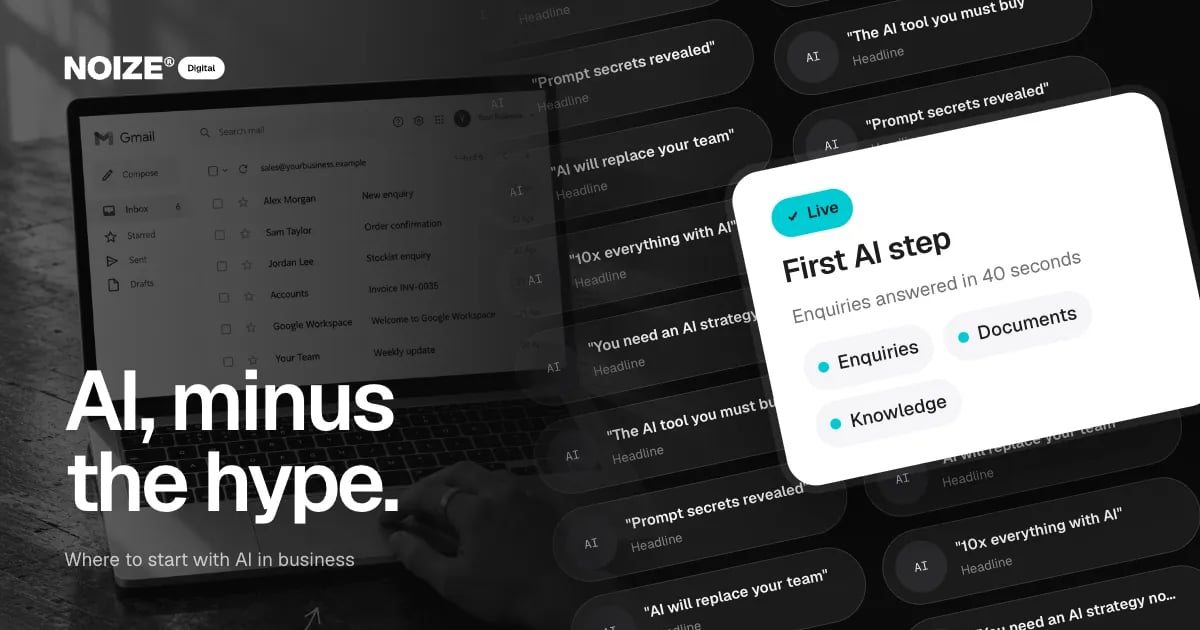
"AI will replace your team." "Ten times everything with AI." "You need an AI strategy now." The headlines are loud, and most of them are aimed at selling something. Meanwhile, owners are left wondering whether they are falling behind, and what, if anything, they should actually do on Monday.
The honest answer is calmer. AI is genuinely useful for some jobs in most businesses. It is not a strategy on its own, and the best results come from starting small with a specific problem.
The short version
- Start with AI where work is repetitive, text-heavy and low risk: enquiries, documents and internal knowledge.
- Measure a baseline, pilot one use case, keep a person reviewing outputs and protect your data.
- If you have built something with AI already, check it is safe before you rely on it.
The short version
Start with AI where the work is repetitive, text-heavy and low risk: answering common enquiries, drafting and summarising documents, and searching internal knowledge. Test one use case, measure the time saved or response improved, keep a human in the loop and protect your data. If you have already built something with AI, check it is safe before it goes live. NOIZE Digital implements AI as part of how the business runs, not as a novelty.
Three practical starting points
01Enquiries
Many businesses answer the same questions every day: pricing, availability, process, location. AI can draft or send accurate first responses in seconds, using information you approve, and hand the conversation to a person when it needs judgement. Faster first replies often mean more enquiries become conversations.
02Documents
Proposals, summaries, reports, policies and emails take hours to draft. AI can produce a first draft from your templates and notes, which a person then checks and finishes. The time saved is real; the final judgement stays human.
03Internal knowledge
Answers often sit in old emails, shared drives and someone's memory. An AI assistant connected to approved internal documents lets staff find procedures, product details and past answers quickly, which helps new starters most.
> I've invested in dozens of ventures, including several building with AI. The ones getting real value aren't chasing every new tool. They picked one painful, repetitive job, measured it before and after, and only then moved to the next.
How to test without risk
- Pick one use case. Specific, frequent and measurable.
- Measure the baseline. How long it takes now, or how fast responses are.
- Run a small pilot. A few weeks with a small group, using approved information.
- Keep a human in the loop. People review outputs, especially anything customer-facing or consequential.
- Measure again. Time saved, speed improved, errors reduced.
- Then decide. Expand, adjust or stop.
Keep control of your data
Before feeding business information into any AI tool, understand where it goes, who can access it and whether it is used to train the tool. Customer data, financial records and confidential documents need particular care. NOIZE IT and Digital work together on access, security and the policies that keep AI use safe, and Legal can help where privacy obligations apply.
Built something with AI already?
Many businesses now have tools or websites built quickly with AI. They can work well, but they can also contain security gaps, exposed data or fragile code. VibeCheck is NOIZE Digital's fixed-price audit for AI-built products. You built it with AI. We check if it is safe to ship.
“Things really got moving beyond our expectations.”
An illustrative example
Imagine a clinic receiving dozens of website enquiries a day, many asking the same questions about fees and availability. An AI assistant trained on approved clinic information answers common questions instantly and books an appointment or passes complex questions to reception. Response times drop from hours to under a minute, and reception spends its time on patients who need a person.
Where to start this week
List the questions your team answers most often and the documents they draft most often. Pick the one that takes the most combined time each week. That is your first AI use case. See digital.noize.com.au.
Setting simple rules for AI use
Before rolling AI out, agree a few rules. Which tools are approved. What information can and can't be entered. Who reviews customer-facing outputs. How mistakes are reported. A short policy protects the business and gives staff confidence to use AI well rather than avoiding it or using it carelessly.
Where AI isn't the answer
AI is poor at decisions that need context, accountability or empathy, and it can produce confident but wrong answers. It shouldn't make final calls on pricing, legal positions, financial advice or sensitive customer issues. Use it to prepare, draft and summarise, and keep people responsible for decisions.
Building on solid systems
AI works best on top of connected systems and clean data. An assistant answering enquiries needs accurate, current information. A document tool needs good templates. That is why AI implementation at NOIZE usually sits alongside integration and automation work in Digital, with IT handling access and security.
Questions to ask before you start
Ask which questions your team answers most often. Ask which documents take longest to draft. Ask where knowledge is hard to find. Ask what data must never leave the business. Ask how you will measure the result. The answers point to a safe first AI project.
Related reading
- What a business website should actually do
- The hours your team re-types every day: automation for small business
Common questions
How can a small business use AI?
Common starting points are answering enquiries, drafting documents and searching internal knowledge.
Is AI safe for business data?
It can be, with the right tools, settings and policies. Understand where data goes before using any tool.
Will AI replace my staff?
For most small businesses, AI removes repetitive tasks rather than roles, freeing people for higher-value work.
What is VibeCheck?
A fixed-price audit from NOIZE Digital for products built with AI, checking whether they are safe to ship.
How much does AI implementation cost?
It depends on the use case. Starting with a small pilot keeps costs low and proves value first.
Do we need an AI policy?
A short one helps. It sets which tools are approved, what data can be used and who reviews outputs.
Can AI answer customer enquiries accurately?
For common questions, when it is limited to approved information and reviewed regularly. Complex or sensitive enquiries should go to a person.
What is the first step in an AI project?
Choose one specific, frequent task, measure how long it takes now and run a small pilot.
Can AI connect to our existing systems?
Often, yes. Digital can connect AI tools to your CRM, documents and knowledge sources with appropriate access controls.
Can AI write our marketing content?
AI can help draft and edit, but content should be reviewed by people who know the brand and the customer.
How do we measure AI success?
Compare time taken, response speed or error rates before and after the pilot.
Do you work with businesses outside Queensland?
Yes. NOIZE Digital works with businesses across Australia, with most projects delivered remotely and in-person workshops where useful.
Your first strategy conversation is on us.
Have a chatThe brand for business.